About this knife

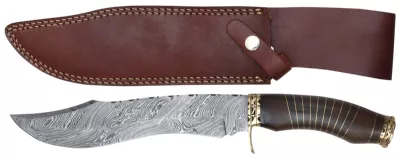
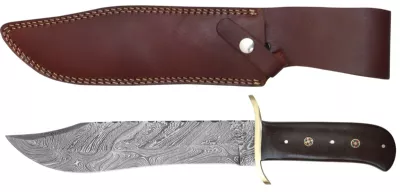
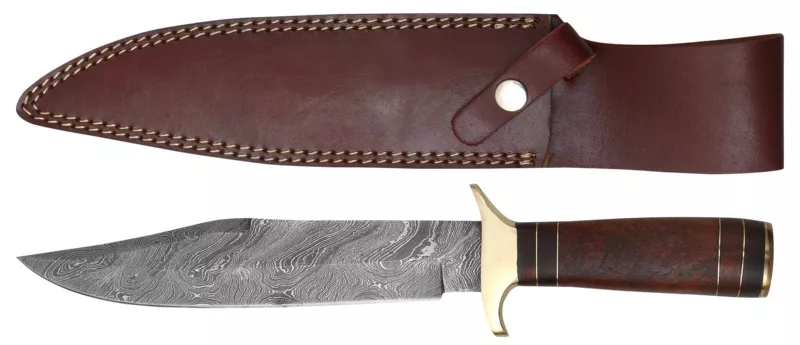
This fixed-blade Bowie knife features a 24 cm hand-forged Damascus steel blade with a curved brass guard and a 14 cm walnut wood handle banded with brass and black rings. Manufactured in Pakistan, it ships in a brown leather case with gold stitching. A wholesale item for retailers targeting Damascus Bowie knife collectors.

Specifications

Manufacturer
Pakistan Knives Factory, Sialkot, Pakistan
Weight
0.656 kg
Blade size (cm)
24
Handle size (cm)
14
Blade
Damascus steel
Handle
Walnut wood
Included
Leather case
Total length (cm)
38
Knife Notes

Know-how from our Sialkot workshop

Did you know?

Many early Bowie knives came from Sheffield

The Bowie knife is an American legend, yet in the mid-1800s a large share of the Bowies sold in the United States were made in Sheffield, England, and shipped across the Atlantic. Cutlery centres have always followed demand. Today Pakistani Damascus knives such as this walnut-handled Bowie carry the same broad-bladed pattern to buyers around the world.
Questions & answers

Bowie questions from collectors and shops

What does this Damascus Bowie cost in Pakistan?

US$38.50 per piece (PKR 11,280 for buyers in Pakistan). From 50 pieces the price drops to US$26.95 per piece. For a larger order, send us the quantity on WhatsApp or by email and we will quote a lower rate.

How long is it overall?

It measures 38 cm from tip to butt: a 24 cm blade and a 14 cm walnut handle, with the curved brass guard where they meet. The brown leather case with gold stitching is made for that length, so the knife travels and stores safely.

Which one to choose

Walnut, bone or horn: choosing a Damascus Bowie

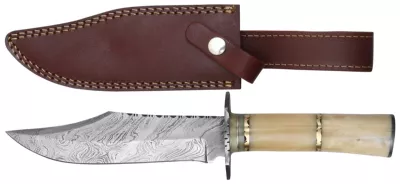
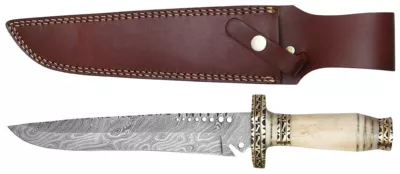
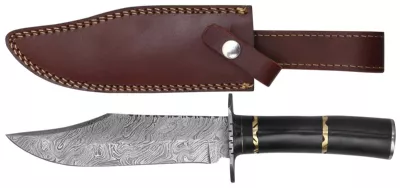
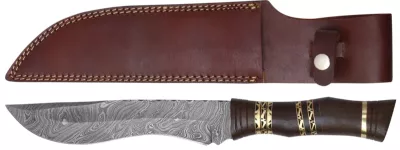
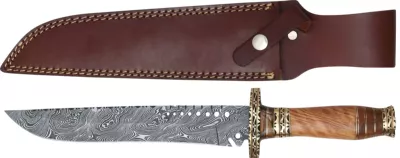
This is the longest Bowie in the Damascus range, with a 24 cm blade, a curved brass guard and a walnut handle banded in brass and black. For shops buying wholesale Bowie knives, the siblings below cover other tastes and sizes:

How to use

Wearing a long Bowie in its leather case

A 38 cm knife on the belt needs a little thought to carry comfortably:

  1. If the case has a belt loop, thread the belt through it before buckling, so the case hangs freely on your strong side.
  2. Position it just behind the hip, where it will not dig into your thigh when you sit or bend.
  3. Guide the blade in slowly, edge away from the stitched seam, so it never cuts into the thread.
  4. Draw it straight up and out by the walnut handle, keeping your other hand clear of the case mouth.
  5. At home, store the knife outside its case so the leather cannot hold moisture against the steel.

Most Bowie-sized Pakistani knives carry best this way on outdoor trips.