
About this knife

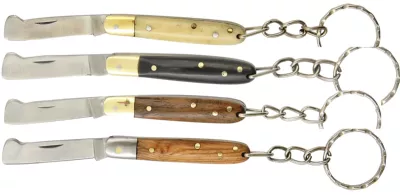
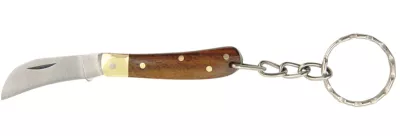
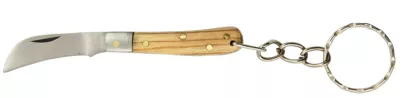
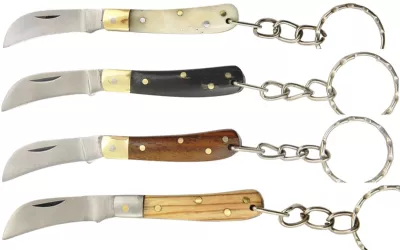
This folding grafting knife keychain combines a stainless steel blade with a 5.5 cm teak wood handle and a polished brass bolster, finished with brass pins for a warm, coordinated look. Compact enough for everyday carry, it doubles as a functional gardening and grafting tool. Available to distributors and retailers on wholesale terms, with rates that scale by quantity.

Specifications

Weight
0.023 kg
Blade size (cm)
4.5
Handle size (cm)
5.5
Blade
Stainless steel
Handle
Colored wood
Bolster
Brass
Knife Notes

Know-how from our Sialkot workshop

The story

Budding season and the knife built for it

Rose and fruit nurseries still rely on budding, a form of grafting in which a single bud, with a sliver of bark attached, is slipped under the bark of a rootstock in summer, when the bark lifts away easily. The technique called for a dedicated tool: a keen straight blade for the incision, and a thin, flat end for easing the bark open.

This teak keychain shrinks that pattern to a 4.5 cm stainless blade and a 5.5 cm handle with a brass bolster and brass pins. It is a real grafting knife in miniature, light enough to carry daily and handy for the small cuts that turn up in a garden every week.

Questions & answers

Quick answers on the teak grafting keychain

What does this teak grafting keychain cost in Pakistan?

US$1.48 per piece (PKR 914 for buyers in Pakistan). From 50 pieces the price drops to US$1.04 per piece. For a larger order, send us the quantity on WhatsApp or by email and we will quote a lower rate.

Did you know?

Every navel orange tree began as a graft

Navel oranges have no seeds, so they cannot be grown from a pip. Every navel orange tree descends from a single mutated tree found at a monastery in Bahia, Brazil, in the early 1800s, and has been propagated by budding and grafting ever since. One of two trees planted in Riverside, California, in 1873 still stands there today. A small Pakistan steel knife like this teak grafting keychain belongs to the same quiet tradition of clean cuts.

Quality check

Nursery buyers' checks for teak grafting keychains

Grafting knives are judged on the edge, so put the cutting test first:

  • Slice a sheet of paper: the 4.5 cm blade should cut cleanly from heel to tip, without tearing.
  • Check that the squared tip is smooth, so it lifts bark without catching.
  • Make sure the blade sits centred in the 5.5 cm teak handle when closed.
  • Look for brass pins set flush and a bolster with no gap against the wood.
  • Allow for natural grain and shade variation in the teak.

A sample of five from each carton is enough for a confident decision.