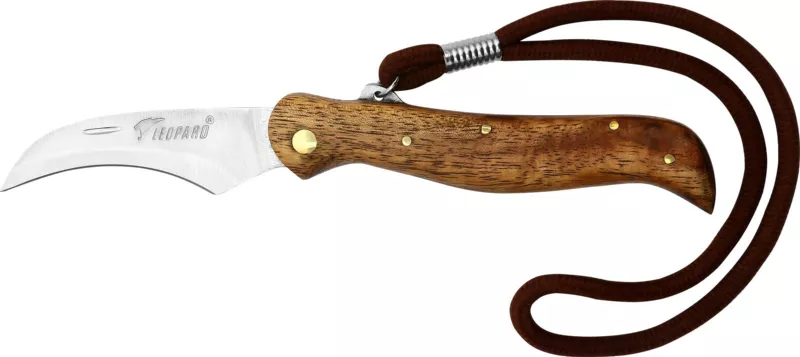
About this knife

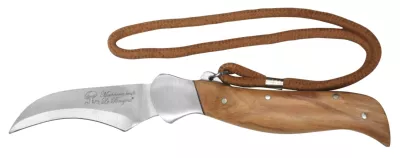
This mushroom knife pairs a 7.5 cm curved, partially serrated blade with a 12 cm rosewood-toned acacia wood handle and a braided cord lanyard, built without a separate bolster. Manufactured in Pakistan, its rich reddish-brown grain gives it a premium look among the mushroom knife range. A wholesale item for retailers targeting foraging and mycology customers.

Specifications

Manufacturer
Pakistan Knives Factory, Sialkot, Pakistan
Weight
0.096 kg
Blade size (cm)
7.5
Handle size (cm)
12
Blade
Stainless steel
Handle
Acacia wood
Knife Notes

Know-how from our Sialkot workshop

Did you know?

One honey fungus covers nearly ten square kilometres

A single honey fungus in Oregon's Blue Mountains spreads underground across nearly ten square kilometres, which makes it one of the largest living organisms known. The mushrooms a forager cuts are only its fruiting bodies, short-lived spore-bearing caps above a network that may be thousands of years old. A curved pocket knife made in Pakistan harvests that small visible part and leaves the rest to keep growing.

Which one to choose

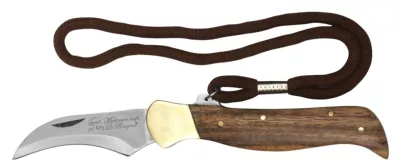
Choosing the bolster-free rosewood-tone version

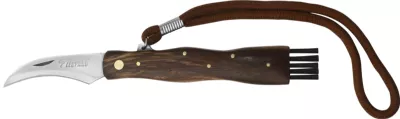
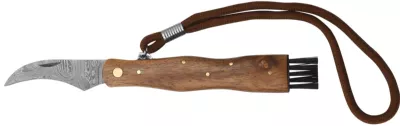
Each of these knives from Pakistan shares a curved, partially serrated 7.5 cm blade and a 12 cm handle, so the decision rests on looks and extras. This one is the simplest in outline: rosewood-toned acacia running without a separate bolster, plus a braided lanyard.

Questions & answers

Rosewood-tone knife: lock, price and cord care

Does the lock mechanism feel secure?

You can test that in a moment. Open the blade until it stops and hold the acacia handle firmly: there should be no movement at the pivot when you press on the spine. The blade should close only when you push it on purpose, never fall shut by itself, and it should come to rest centred. Report any knife that does not pass.

What does this pocket knife cost for buyers in Pakistan?

US$4.10 per piece (PKR 1,648 for buyers in Pakistan). From 50 pieces the price drops to US$2.87 per piece. For a larger order, send us the quantity on WhatsApp or by email and we will quote a lower rate.

How do I clean the braided lanyard?

Rinse it in warm soapy water after a muddy outing, squeeze it out and let it dry fully before the knife goes back in a drawer, so damp cord does not sit against the wood for days.

Sharpening

Keeping a hooked, part-serrated edge keen

A curved combination edge needs two tools: a small stone for the plain section and a tapered rod for the serrations.

  1. Find the bevelled side of the serrations; on most pocket knives they are ground on one side only, with the other face flat.
  2. Work each scallop with a tapered ceramic or diamond rod, matching its curve and the existing angle, a few light strokes apiece.
  3. Sharpen the plain section at around 20 degrees, lifting the handle slightly as you move along the hook so the whole curve meets the stone.
  4. Remove the burr from the flat face with one light pass, then wipe the stainless Pakistan pocket knife clean before folding it.