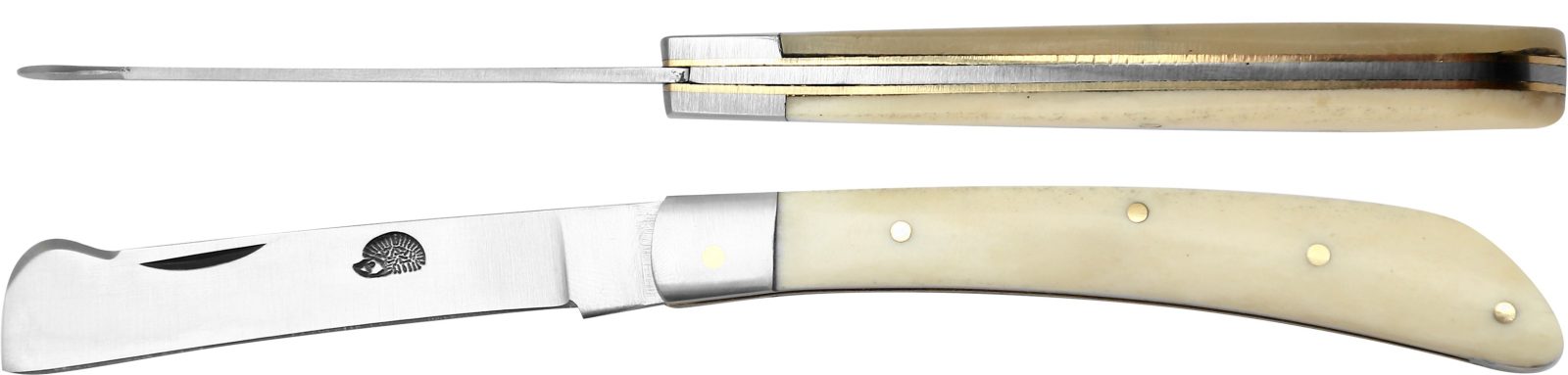

Grafting Knives Ref. 3645

Reddish Wood Handle Flat-Blade Grafting Knife – 10 cm Handle, Inox Bolster

This flat-blade grafting knife has a reddish acacia wood handle, inox bolster, 10 cm, made in Pakistan.

$4.10
Unit price. Rates are degressive by quantity, size and material.
Wholesale $2.87
Ask about this item on WhatsApp
  • Factory direct Sialkot, since 1982
  • Worldwide shipping
  • Private label on request
  • Wholesale pricing by quantity

About this knife

This grafting knife pairs a 7.5 cm flat, spatula-tipped blade with a 10 cm reddish acacia wood handle and a polished inox bolster. Manufactured in Pakistan, the squared-off tip suits lifting bark and making clean grafting cuts. A wholesale item for retailers wanting an acacia wood-handle grafting knife.

Specifications

Weight
0.068 kg
Blade size (cm)
7.5
Handle size (cm)
10
Blade
Stainless steel
Handle
Acacia wood
Bolster
Inox
Knife Notes

Know-how from our Sialkot workshop

How to use

Whip-and-tongue grafting with a flat blade

The whip-and-tongue graft joins a scion and a rootstock of the same thickness, usually in late winter or early spring. A flat, straight edge like this 7.5 cm spatula-tip blade suits it, because it cuts the long faces truly flat.

  1. Make one long slanting cut across the top of the rootstock, roughly three times as long as the stem is thick, in a single draw of the grafting knife.
  2. Make an identical cut at the base of the scion.
  3. On each face, cut a short tongue: a slit starting about a third of the way down from the tip, running roughly with the grain.
  4. Slide the two pieces together so the tongues interlock and the bark lines up on at least one side.
  5. Bind firmly with grafting tape and seal the tip of the scion.

The story

Older than the orchard itself

Grafting is one of the oldest techniques in horticulture. Theophrastus, the Greek botanist who succeeded Aristotle, wrote about it in the fourth century BCE, and Roman farm writers such as Cato and Pliny the Elder described several methods, some barely changed today. For centuries the job was done with ordinary pruning blades.

The dedicated grafting knife, with a straight edge for flat cuts and a spatula end or bark lifter for opening bark, had become a standard nursery tool in Europe by the nineteenth century. This acacia-handled model is a traditional Pakistani knife in that line, made in Sialkot for the same patient work.

Pro tip

Hold the joint up to the light

Before binding a whip graft, press the two cut faces together and hold them up against the sky. Any glimmer of light between them means a gap the callus cannot bridge, so take one more fine slice rather than wrapping a poor fit. A Pakistan knife with a wood handle like this acacia model gives the control for that last shaving: the 10 cm handle sits steady in the palm while the flat blade does the work.

Questions & answers

Acacia, edge and pricing questions

How good is the quality of a Pakistan knife like this one?

Check what matters for grafting. The 7.5 cm spatula-tip blade is stainless and should arrive with a clean, keen edge; the reddish acacia handle should be smoothly finished and flush with the inox bolster; and the blade should open firmly and close deliberately. These are the details orchard buyers abroad use to judge Sialkot workshops.

What is the price of this acacia grafting knife in Pakistan?

Buyers in Pakistan find the unit price in rupees (PKR) at the top of the page. Ordering for a shop or a cooperative? The price per knife falls with quantity, so contact us on WhatsApp or by email for a wholesale quote.

Does acacia mind getting wet?

Acacia is dense and copes well with damp, but no wood likes standing water. Dry the handle after a wet session and give it a little mineral or linseed oil now and then to keep the reddish colour deep.