
Grafting Knives Ref. 3649

Two-Tone Bone & Horn Handle Grafting Knife – 10 cm Handle, Inox Bolster

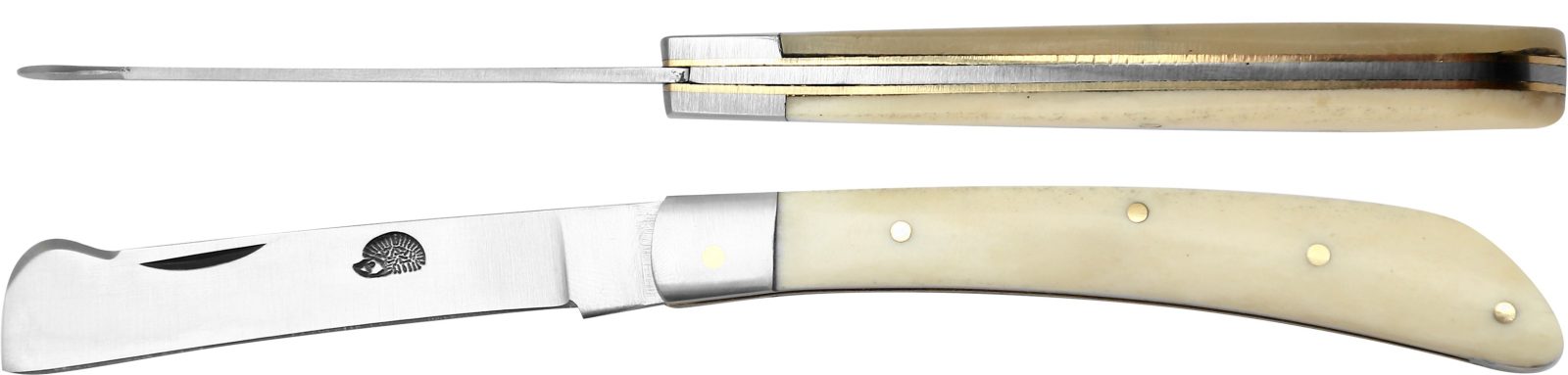
This grafting knife has a two-tone white bone and black horn handle, inox bolster, 10 cm, made in Pakistan.

$4.35
Unit price. Rates are degressive by quantity, size and material.
Wholesale $3.05
Ask about this item on WhatsApp
  • Factory direct Sialkot, since 1982
  • Worldwide shipping
  • Private label on request
  • Wholesale pricing by quantity

About this knife

This grafting knife combines a 7.5 cm hooked blade with a 10 cm two-tone handle pairing white bone and black horn sections, finished with a polished inox bolster. Manufactured in Pakistan, the contrasting materials make it a distinctive option in the grafting knife range. A wholesale item for retailers wanting a standout two-tone grafting knife.

Specifications

Weight
0.079 kg
Blade size (cm)
7.5
Handle size (cm)
10
Blade
Stainless steel
Handle
Bone & horn black
Bolster
Inox
Knife Notes

Know-how from our Sialkot workshop

How to use

Cleft grafting: shaping the scion wedges

Cleft grafting, done in late winter or early spring, top-works a branch too thick for a whip graft. The hooked 7.5 cm blade shapes the scions; the heavy splitting is not its job.

  1. Saw the branch off squarely and split the stub down the middle with a cleaving tool or an old chisel tapped in with a mallet, never by levering with a folding knife.
  2. Wedge the split open, then shape the base of each scion into a long, tapering wedge with two clean cuts of the grafting knife, leaving the outer side slightly thicker.
  3. Push a scion into each side of the cleft so its cambium, the green layer under the bark, meets that of the stock.
  4. Remove the wedge so the stub grips the scions, and seal every cut surface with grafting wax.

Care & maintenance

Bone meets horn: caring for a two-tone handle

Bone and horn react differently to moisture: bone can crack if it dries too fast, while horn can swell if it stays wet. The seam between them on this 10 cm handle is where trouble would show first.

  • Dry the whole handle as soon as work is done, paying attention to the line where bone meets horn.
  • Never soak the knife or wash it in a dishwasher.
  • A drop of mineral oil every few months feeds both materials; buff off the excess.
  • Store it away from radiators and sunny windowsills.
  • Clean sap from the hooked blade with alcohol, and oil the pivot lightly.

Treated this way, a Pakistan folding knife with natural handle materials keeps its contrast for many seasons.

The story

Two natural materials on one handle

Before plastics, cutlers worked with what farms and forests supplied: wood, bone, horn and antler. Bone gave a pale, smooth handle and horn a dark, warm one, and craftsmen learned early to combine them in bands, spacers and inlays, for decoration as much as for grip.

This two-tone handle follows that old idea, with white bone and black horn sections meeting along its 10 cm length, finished by an inox bolster. Sialkot workshops have long worked with both materials, and a Pakistan knife like this one shows how simple contrast, rather than added ornament, can make a working grafting tool look special.

Questions & answers

Joins, weight and price of the two-tone knife

How good is the quality of a Pakistan knife like this one?

Two natural materials make the fitting harder to hide, so look at the joins. The white bone and black horn should meet cleanly, both should sit flush to the inox bolster, and the 7.5 cm hooked blade should open firmly and close deliberately, centred in the handle. At about 79 g, it has a reassuring weight in the hand.

What does this two-tone grafting knife cost in Pakistan?

For visitors in Pakistan, the unit price is listed in rupees (PKR) at the top of this page. If you are buying for a shop, tell us the quantity on WhatsApp or by email; wholesale rates fall as volume rises.

Is the split between bone and horn the same on every knife?

Close, but not identical. Natural bone varies in shade and horn in its depth of black, so each handle has its own balance of light and dark. That small variation is part of what buyers like about natural handles.