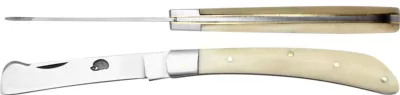

About this knife

This grafting knife pairs a 7.5 cm hooked blade with a 10 cm white bone handle and a polished inox bolster. Manufactured in Pakistan, its light-toned bone suits retailers wanting a natural-material full-size grafting knife. A wholesale item for retailers targeting orchard and vineyard customers.

Specifications

Manufacturer
Pakistan Knives Factory, Sialkot, Pakistan
Weight
0.076 kg
Blade size (cm)
7.5
Handle size (cm)
10
Blade
Stainless steel
Handle
Bone
Bolster
Inox
Knife Notes

Know-how from our Sialkot workshop

Best uses

Vines, roses and scions: jobs for a hooked bone knife

Its 7.5 cm hooked blade pulls through green wood with little effort, so this grafting knife moves easily between grafting and pruning, while the 10 cm white bone handle stays comfortable through long sessions.

  • Preparing scions for cleft grafts
  • Winter pruning of vines
  • Deadheading and shaping roses
  • Removing rootstock suckers
  • Cutting twine and tree ties
  • Cutting flowers for the house
Questions & answers

Hooked bone model: practical questions

What does it cost to buy this grafting knife in Pakistan?

US$4.35 per piece (PKR 1,718 for buyers in Pakistan). From 50 pieces the price drops to US$3.05 per piece. For a larger order, send us the quantity on WhatsApp or by email and we will quote a lower rate.

Does it have a bark lifter?

This model is listed with the hooked blade alone. For T-budding or bark grafting, the 10 cm bone model with a folding bark lifter adds that second tool.

Which one to choose

Same size, different handle or an extra tool

Several knives in the range share the 10 cm handle and the 7.5 cm hooked blade; what separates them is the handle material and whether a bark lifter comes with it. A Pakistan knife with a bone handle has a pale warmth the others lack, but here are three alternatives:

The story

From the Roman vine knife to the modern hook

The hooked blade has a long history in the vineyard. Columella, writing on agriculture in first-century Rome, described the vine-dresser's knife, the falx vinitoria, in detail, naming each part of its curved blade and the job it did. The shape survived because it works: a hooked edge pulls through a cane rather than pushing against it, so the cut is clean and the hand stays in control.

Gardeners across Europe kept using hooked knives for pruning and grafting into modern times. Pakistan knives of this pattern, with a white bone handle and an inox bolster, carry that design into today's orchards and vineyards.