About this knife

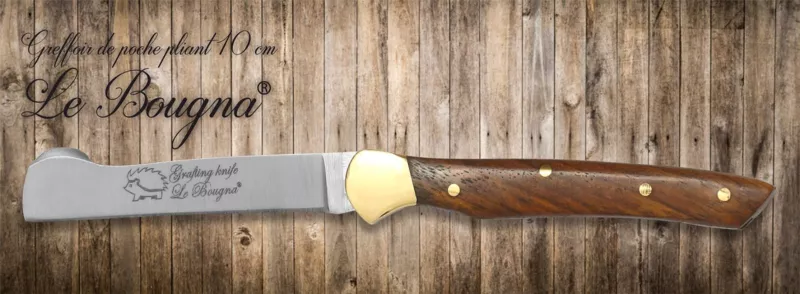
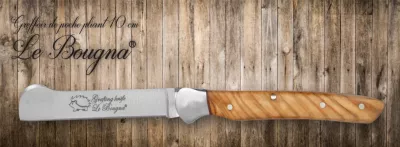
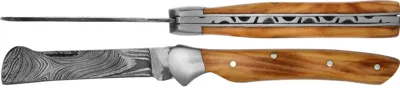
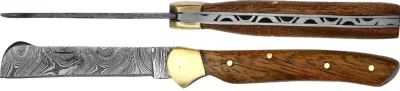
This grafting knife pairs an 8.5 cm straight blade with a 10 cm warm acacia wood handle and a polished brass bolster. Manufactured in Pakistan, its full-size build suits regular orchard and vineyard grafting work. A wholesale item for retailers wanting a wood-handle grafting knife with a brass accent.

Specifications

Manufacturer
Pakistan Knives Factory, Sialkot, Pakistan
Weight
0.064 kg
Blade size (cm)
8.5
Handle size (cm)
10
Blade
Stainless steel
Handle
Acacia wood
Bolster
Brass
Knife Notes

Know-how from our Sialkot workshop

Pro tip

Use the whole blade, not just the tip

Beginners tend to saw at scion wood with the last part of the edge, which leaves a ridged face that will not knit. With this grafting knife, start the cut near the brass bolster and draw the full 8.5 cm straight blade through the wood in one long, steady pull. A single stroke gives a flat surface; a second stroke rarely improves it.

Questions & answers

Acacia handle, origin and price: buyers' questions

What is the price of this acacia grafting knife in Pakistan?

US$3.60 per piece (PKR 1,508 for buyers in Pakistan). From 50 pieces the price drops to US$2.52 per piece. For a larger order, send us the quantity on WhatsApp or by email and we will quote a lower rate.

Is it suitable for vineyard grafting?

Yes. Its full-size build suits regular orchard and vineyard work: the straight blade is long enough for the sloping cuts used in bench grafting vines, and the 10 cm acacia handle fills the hand comfortably through a long session.

Display & retail

Warm acacia and brass on a spring counter

Acacia's honey-to-reddish tones and a polished brass bolster give this knife the warmest look in the stainless grafting range, and warm colours sit well beside green plants and terracotta pots.

  • Set it near the fruit trees and rootstocks in late winter, with grafting tape and wax alongside.
  • Pair it on the shelf with the glossy black version: same size, same brass, different character, so customers compare and choose.
  • Leave one open so the straight blade shows its full 8.5 cm length.
  • Mention on the price card that every acacia handle has its own grain.

The card can also note that the Pakistani blade is stainless, a reassurance for any outdoor tool.

The story

More than two thousand years of cleft, splice and bud

Few gardening skills have a longer written record than joining one plant onto another. The Greek philosopher Theophrastus described it in the fourth century BC, and Roman farm writers such as Cato and Columella gave instructions for cleft grafting and for sealing the union with clay. Their basic rules, a clean cut and close contact between the living layers, still hold.

The tool evolved with the trade. As commercial nurseries grew in Europe and North America in the eighteenth and nineteenth centuries, budding and grafting became daily work, and the folding grafting knife became a standard part of the nurseryman's kit. In Pakistan, the same skills keep Punjab's orchards productive: kinnow mandarins are budded onto rough lemon rootstock, and mango varieties are propagated by grafting. A full-size knife with a straight 8.5 cm blade belongs to that working tradition.